


Before the Australian elections, candidates, consultants and political parties could concentrate to what young people think. And in the event that they usually are not, they needs to be.
This selection shall be the primary one through which Z and Millennial voters (18 to 40 years) shall be is inferior to inferior baby boomers (60–79 years). Many of those young people were in the highschool through the two previous elections.
While there are concerns concerning the effectiveness of citizenship and citizenship education, there are concerns There can be evidence Young individuals are excited by many topics and lively.
So what interests young people most? We have analyzed 1000’s of letters from young Australians to search out out.
What is significant for young people?
In the past 20 years, young people have told us of what is significant to us as a part of Whitlam Institute What counts? Writing competition. The students within the years 5 to 12 can write about every thing they need. Most are guided by their schools to make a contribution as a part of their Civics curriculum. Some resolve to participate within the competition.
A singular sample, Our evaluation From 22,500 entries from 2019 to 2024, insights into the issues which can be most well received by this generation.
We have identified joint topics: society and democracy, mental health, environment and climate change, cross -generational justice and (social) media.
1. Society and democracy
We found that young people in an increasingly fragmented political landscape actively take care of complex and diverse topics. They are also concerned about anti -democratic forces.
They reflect on what makes this moment extraordinary – climate change, war and violence, faster technological change – and consider measures which can be crucial by individuals, communities and institutions in order that they’ve a future.
Our research shows that young people prioritize the care in local and global futures, peer support, family, bonds between the generations and connections between communities and borders. The most typical topic was the family, followed by pollution, racism and poverty.
An ethics of care shapes your sense of belonging and your responsibility – and the responsibilities of the federal government. As a senior student wrote in 2022:
Children are abused or observed how one in every of their parents is misused countless times. The government must properly do its work through the use of more practical ways to assist children and their parents get out of uncertain environments.
Our mood evaluation shows that you simply write with hope – and infrequently with fear and fear.
2. Mental health
Many young people write about “health”, including physical health and health of communities and natural environments. Most of the time, nonetheless, they write about mental health and the causes of concern, distress and illness.
Young people want governments and leaders to tackle the causes of the causes of diseases. In other words, they wish to act as to what the drivers of the disease creates, including climate change, inequality and loneliness.
For political decision -makers and supporters, which means mental health is related to broad social and political questions – problems that young people imagine that governments take well -being seriously.
3 .. Environment and climate change
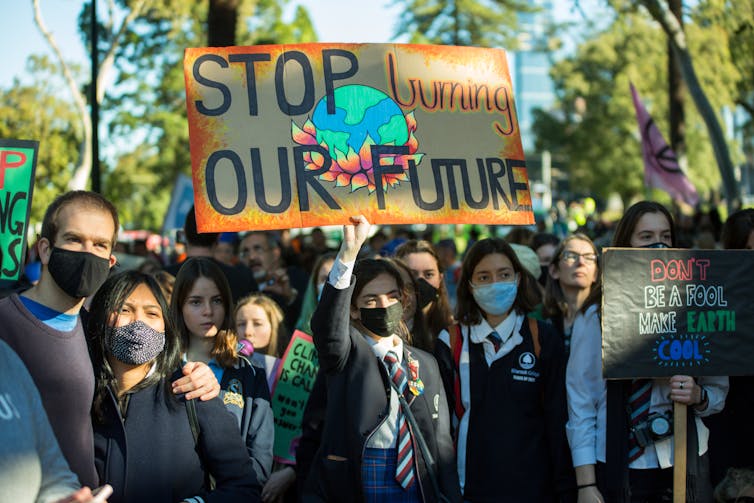
Environmental problems, especially climate change, were dominant topics – More than in previous years. The students write about their relationship with the environment and some great benefits of reference to nature.
Shutter stick
Some call out extractive relationships with the environment, especially large firms. They call for urgent measures by individuals and institutions and are committed to guidelines that prioritize future generations and the planet.
An older student wrote 2019:
Our future is threatened because of climate change […] It is the longer term of our generation that’s at stake, but we’re still unknown.
4. Justice between the generations
Young people consider cross -generational justice and social justice as interconnected and demand climate protection, economic opportunities and democratic participation. Your concerns reflect a commitment to human rights, including refugee rights, gender equality and indigenous justice.
Your letter shows awareness of the role of Australia on the planet. Many discuss global conflicts and the responsibility of the nations in promoting peace and security. They wish to contribute to efforts to tackle these problems.
Young people wish to trust in Australian democracy and play more role. They want those in power and the institutions and agencies to be was once more transparent, communicate often and truthfully and show how they take measures for a greater future for all generations.
Key areas through which young people want greater accountability are in the federal government, within the media and in business. The twelve -year -old Ivy said in an interview:
Small children must have a direct voice in parliament […] Adults would take us seriously as a substitute of just considering us as just children. If problems affect or this generation in the mean time, it’s best to have a say within the parliament.
Young people want their activism and their efforts to be recognized and supported. They hope for a democracy through which they not only heard, but are actively involved by leaders with a direct voice in the federal government (in any respect levels) and institutions.
5. (Social) media
The benefits and drawbacks of young people underline the social media disadvantages and demand strategies that deal higher with them to scale back the damage and maximize the benefits.

Shutter stick
They emphasize the necessity for digital competence to critically navigate online information and need online environments to be supportive and protected.
Young individuals are concerned about how they’re generally represented within the media. They argue that integrative and precise representations are the keys to listen to and respect their voices – crucial for sensible bourgeois participation.
Candidates for termination
Young people usually are not just future voters – they coordinate in the subsequent elections.
The young people, whose writing we now have analyzed, formed bourgeois and political values in Australian and world history: catastrophic bush fire and floods, a climate crisis, a pandemic and digital technologies that change our lives.
They reject the concept that they’re too young to know problems and as a substitute desire a participatory democracy through which their voices influence real decisions. In fact, the general public has shown the will to go away young people more with sayings.
Our evaluation shows that lots of the 18 to 24 -year -old voters are informed, committed and willing to carry managers accountable for this 12 months. You want measures against the climate, mental health, economic justice and democratic accountability. You are uninterested in ignoring and becoming out.
image credit : theconversation.com