


There are trillion invited particles – Protons And ElectronsThe basic constructing blocks of matter – around the top at a certain cut-off date. These energetic particles, which may move across the speed of sunshine nearby, typically remain 1000’s of kilometers from the earth which might be caught there by the form of the magnetic field of the earth.
Occasionally, nonetheless, an event happens that was misplaced and sends electrons Rain rain into the earth's atmosphere. These energetic particles in space make up what is named because the one Van Allen radiation beltsAnd their discovery was considered one of the primary in space age. A brand new study From my research team, it found that electromagnetic waves which might be generated by lightning can trigger these electron shower.
A brief history hour
At the start of the space race within the Fifties professor James van Allen And his research team on the University of IOWA was commissioned to construct an experiment to fly the United States' first satellite. Explorer 1. You have designed sensors for learning cosmic radiationwhich is brought on by high-energy particles that come from the sun, the milky way galaxy or beyond.
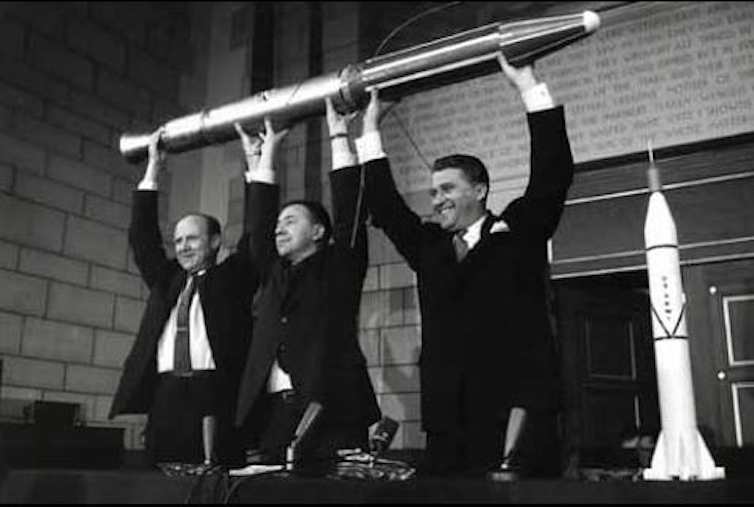
NASA
After the beginning of Explorer 1, nonetheless, they found that their instrument recognized considerably Higher radiation level than expected. Instead of measuring a distant radiation source beyond our solar system, they appeared to measure an area and intensely intensive source.
This measurement led to The discovery of The van All-radiation belts, two tay-shaped regions with energetic electrons and ions that surround the planet.
Scientists consider that the inner radiation belt, which is about 1000 kilometers from the earth of around 621 miles, consists of electrons and high -energy protons and is comparatively stable over time.
The outer radiation belt, about 3 times further away, consists of high -energy electrons. This belt Can be very dynamic. Its location, the density and the energy content can vary significantly in response to solar activity.
https://www.youtube.com/watch?v=kdtmdogsqe
The discovery of those high -raying regions isn’t just an interesting story concerning the early days of the space race. It also serves as a memory that many scientific discoveries have arisen from a completely satisfied accident.
It is a lesson for experimental scientists, I includedto be open to the evaluation and evaluation of knowledge. If the information doesn’t match our theories or expectations, these theories could have to be visited again.
Our curious observations
While I teach the history of the space race in an area policy course on the University of Colorado, Boulder, I rarely mix it with my very own experience as a scientist who researches the radiation belt on earth. Or no less than I didn't do it until recently.
In considered one of Max Feinland, a student in my research group, under the direction of Max Feinland we got here across a few of our own Unexpected observations The radiation belt of the earth. Our findings have caused us to rethink our understanding of the inner radiation belt of the earth and the processes affected.
Originally we made our option to very fast subsequent seconds Plug with energy -faces electrons Enter within the atmosphere from the outer radiation belt, where they’re typically observed.
Many scientists consider that a form of electromagnetic wave, referred to as the “chorus”, can knock these electrons out of the position and send it to the atmosphere. You are called choral waves as a result of your clear chirping When they’re listened to on a radio receiver.
Feinland developed an algorithm to look for these events in many years of measurements from the Sampex satellites. When he showed me an motion with the place of all events that he had discovered, we noticed that a few of them weren’t where we expected. Some events mapped the inner radiation belt fairly than the outer belt.
This finding was strange for 2 reasons. On the one hand, choral waves on this region should not widespread, so something else needed to shake these electrons easily.
The other surprise was to seek out electrons within the inner radiation belt so vigorously. Measurements from Nasas van Allen probe mission led to a brand new interest within the inner radiation belt. Observations from the Van Allen-probes indicated that high-quality electrons are often not present In this inner radiation belt, no less than not in the primary years of this mission, from 2012 to 2014.
Our observations now show that there are indeed times when the inner belt comprises high -energy electrons. How often is that this true and under what conditions stays to be researched. These energetic particles Can damage the spaceship And damage people in space in order that the researchers have to know when and where they’re present in space to design higher spaceships.
Determination of the perpetrator
One of the chances of disturbing electrons inside radiation belts and moving into the earth's atmosphere actually begins within the atmosphere itself.
Flash, the massive electromagnetic discharges that illuminate the sky during thunderstorms, can actually generate electromagnetic waves Mandatory generating whistler.

Mdesigner125/iStock via Getty Images Plus
These waves can then fly through the atmosphere into space where they interact with electrons In the inner radiation belt, choral waves interact with electrons within the outer radiation belt.
To test whether lightning was behind our inner radiation belt recognitions, we looked back on the electron storms and compared them Thunderstorm. Some flash activities gave the impression to be correlated with our electron events, but much of it was not.
In particular, only a flash that occurred directly after so -called geomagnetic storms led to the electron eruptions we’ve proven.
Geomagnetic storms are disorders in the virtually earth -end room environment, which are sometimes brought on by large outbreaks on the sun surface. If it’s directed towards the earth, this solar activity can produce what researchers describe for space weather. Space weather can result in breathtaking Auroras, but it may also interfere with satellite and power grid processes.
We found that a mix of weather on earth and weather in space creates the unique electron signatures that we observed in our study. The sun activity disturbs the radiation belt of the earth and populates the inner belt with very high -energy electrons, then the flash interacts with these electrons and generates the fast bursts observed by us.
These results remind a pleasant memory of the character of earth and space. They were also a welcome memory of me of the customarily non -linear means of scientific discovery.
image credit : theconversation.com