


The conditions of strontium isotopes in fossil shark teeth might be used to raised understand how the coastal environments have developed in antiquity published work.
As a paleontologist with the Florida Museum of Natural HistoryPresent We have an interest In understanding the old Florida environments.
Our study was considered one of the primary previous coastal deposits in Florida with fossil shark teeth And a technology That looks at Variations within the ocean's strontium. Strontium is a chemical element that naturally occurs in rock, floor and water.
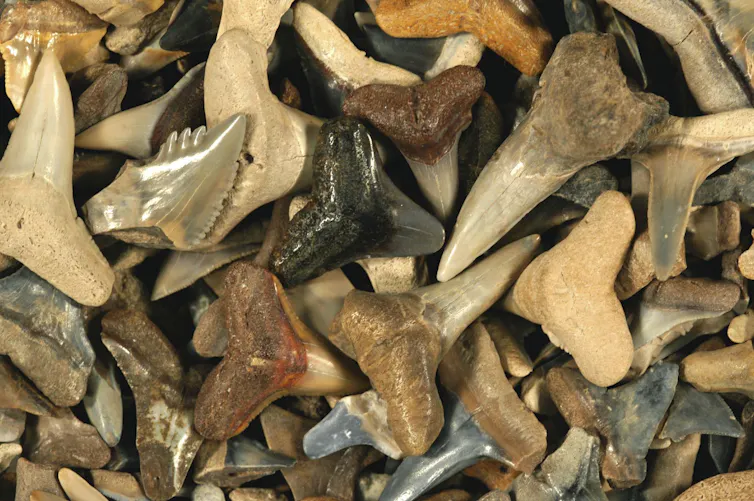
Flmnh/Jeff Gage
Oceanstrontium values change over time, which is finished Measuring the mirror of the chemical element a novel global system To determine the age of comparable sedimentary rock deposits on coasts worldwide.
Changes to the strontium isotope relationships have several causes. Landerosion stores Strontium in oceans, while carbonate-producing marine life produces and releases the development of their skeletons Strontium. Strontium can also be released by deep -sea readers.
Geochemist Donald Depaolo and geologist B. Lynn Ingram discovered Variations within the ocean's strontium By examining strontium -isotopes -relationships in marine sediments, including fossils. The mirrors of the strontium isotopes in marine sediments provide a “time temple”, which at the moment correlates with the strontium value of the ocean water.
This data enabled scientists to map the conditions of strontium isotopes in sea water over time. This global strontium -sea water curve correlates with the Geological time scale. Scientists use the curve to reconstruct the past of oceanchemy and climate conditions in addition to the age of mollusks and other shells producing sea fossils.
Why is it necessary
The key to understanding is true from old sites on how the earth and its living beings have developed over time.
But historically, Strontium dating had reliable, but restrictions.
For example, it really works best in full sea environments and is a challenge to make use of in fossil locations along the coast. This is since the strontium values may very well be influenced by land sediments and fresh water rivers.
In addition, material that’s used for the strontium dating Petrificationthe preservation of once living things from the past. Any necessary chemical change within the fossil can influence the strontium value and end in an inaccurate date.
Our study shows that fossil sharks of sharks are more immune to such a change because of their external enamel -like surface.
Remarkably, fossil sharks of sharks are also incredibly abundant. Haie ruled the oceans of the earth 400 million years and every one grows and dandruff Thousands of teeth To your life.
How we did our work
Fossil locations Florida are unique in that they’re have a few of the richest fossil sediments For necessary times in geological history. These locations may also help us understand changing climate zones, vegetation and sea levels over time.
The Florida Museum of Natural History has one Collection of over 115,000 shark samples from Florida alone.
In order to perform our study, we chosen shark tooth samples from two significant fossil locations in neogen periods in Florida. The neogenic from 2.6 to 23.5 million years was a time of immense change in biological diversity because of climate zones modified climate zones.
We analyzed the strontium that was present in powdered samples by shaving a skinny layer of the surfaces of the teeth. The age of the teeth helped make clear the age of the fossil places where they were collected. This data enabled us to calibrate and distinguish the age of our two locations Montbrook and Palmetto Fauna Bone Valley by about 600,000 years.
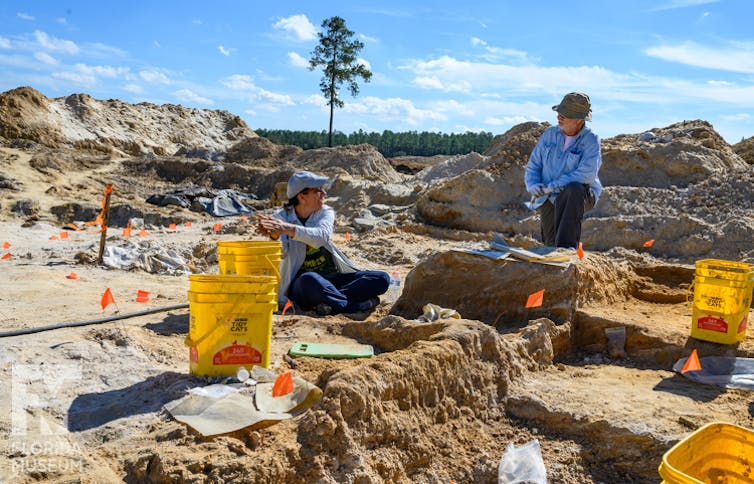
Flmnh/Jeff Gage
Before our study, scientists could only appreciate the age of the locations on mammalic fossils. The locations were considered the identical. Our work offers a more detailed date.
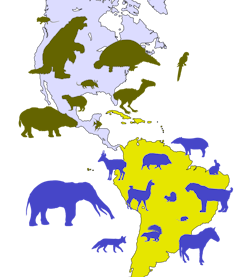
Wikipedia
These age groups offer recent insights into what happened within the southeastern region of North America about 5 to six million years ago. Our revised age scalibras agree with global events, including necessary fluctuations within the sea level and the Great American biotic exchange – The migration of land mammals between North and South America after the founding of Panama's landing was founded 4 to five million years ago.
For example, since certain varieties of floor footards will not be found on the Montbrook (5.85 million years) location, but on the Palmetto Fauna Bone Valley (5.22 million years) location, this implies between these two data.
image credit : theconversation.com