


The Western Australian elections will happen on Saturday, whereby the surveys are closed at 9 p.m. AEDT. A PollPerformed from February 27 to March 5 of a sample of 1,061, Labor gave a 1.5-point profit for staff since a WA newspolle.
Primary votes were 44% staff (as much as two), 29% liberals (three), 5% residents (as much as two), 10% Greens (down two), 3% one nation (down one) and 9% for everybody else (as much as two).
Labor Premier Roger Cook's net permit was one point to +17, 55% met and 38% dissatisfied. The Liberal Leader Libby Mettam's NORD ANOWERS rose by three to +1. Cook LED as a greater premier around 53–34 (54–34 before).
The Poll Bludger reported on Friday Labor gave a head start of 57–43 that a Demosau survey for the West Australian was carried out by a sample of 1,126 from March 4 to five. The primary votes were 43% staff, 30% liberals, 5% residents, 11% Greens and 11% for everybody else. Cook LED as a preferred premier via Mettam of 47–32. The voters thought around 49–31, was in the fitting direction.
On March 2021 WA electionLabor won 53 of the 59 seats of the lower house with a two -party coordination of 69.7–30.3, a record high for a big party in every state or for national elections. Labor won 59.9% of the first votes.
Labor would never match the results of 2021 on this election, but when the outcomes on Saturday reflect the time Poll and Demosau surveys, they may surpass their 2017 resultwon as Labor 41 of the 59 seats with a two-party vote of 55.5–44.5.
Reforms of the upper house
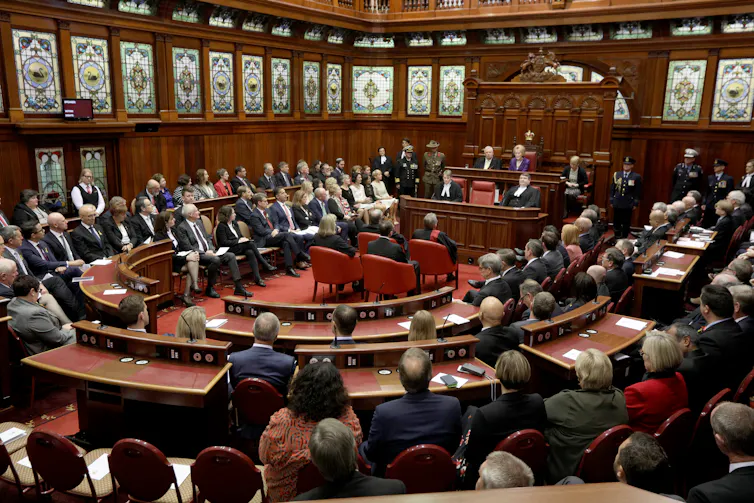
Before this election, WA had six Oberhaus regions, wherein six members were returned. Of the ABC's election pages of 2021 WAThere were three regions of Perth and three non-metro regions. Perth had 75% of the enrolled voters of WA, but only 50% of the upper house seats.
In addition, the mining and pastoral region and the agricultural region had far less enrolled voters than the Southwest region. In these two regions, only 10.1% of the enrolled voters of WA, but 33.3% of the upper house seats.
Richard Wainwright/AAP
Labor's huge victory in 2021 gave them a majority within the upper house for the primary time within the history of the WA, 22 of the 36 seats. Labor used this chance to convert the Oberhaus into A individual nationwide electorate This returns 37 members through proportional representation with optional voters.
According to those reforms, an election rate is 1/38 of the votes or 2.63%. Parties that win about half of the quota have an inexpensive probability of winning a seat. 1.3% might be enough to win. Labor also accomplished the group ticket vote (GTV) and left Victoria the one Australian jurisdiction that this discredited system continues to be used.
The survey that Bludger reported on February 23 Libby Mettam has promised to attempt to return For the old very painted system, when the liberals win the alternative and let go of the principle of a vote. The old system was biased on the liberal and national parties. analyst Kevin Bonham condemned the liberals.
ABC voting analyst Antony Green said there have been 13 groups on the upper house ballot and a complete of 146 candidates. To bring a gaggle box over the road, not less than five candidates were required for this group. The variety of candidates was greater than halved from 2021 when there have been 325 Oberhaus candidates. The coordination of the group cards promoted a distribution of micropartes and candidates.
There will probably be a complete of 398 candidates for the 59 seats within the lower house, from 463 in 2021. Labor, the liberals and the Greens will contest all seats, the Nationals will compete 20, the Australian Christians 54 and a nation 41.
Labor has a giant lead in a SA -State survey
The next election of the South Australian state will happen in March 2026. A. Demosau surveyPerformed from February 18 to 23 from a sample of 1.004, Labor gave a 59–41 lead (54.6–45.4, within the elections in March 2022 Labor). Primary votes were 43% staff, 30% liberals, 10% green and 17% for everybody else.
Bianca de Marchi/AAP
The reigning Laboramt owners Peter Malinauskas led the liberal Vincent Tarzia as the popular premier of 51–23. The voters thought around 53–33 that Sat was in the fitting direction.
The Poll Bludger reported on Monday Election reforms have passed the parliament with which the election night after post and pre-poll votes will be counted. In earlier SA elections, only votes that got at the traditional election day stands were counted on the election night, with other forms of votes lasting not less than just a few days to count.
In the federal a part of this survey, the work listed by 53–47 in SA (54.0–46.0 as much as Labor in SA within the national elections 2022) was cited. The primary votes were 35% coalition, 34% staff, 11% green, 6% one nation and 14% for everybody else. Anthony Albanese led Peter Dutton with 39 to 33 as the popular prime minister and didn’t consider that Australia was led in the fitting direction.
image credit : theconversation.com