


Only just a few cities have experienced a sharper economic change as Detroit.
It was one in every of the The fastest growing cities In the nation between 1900 and 1950.
In the just about 75 years since then, over 60% of its population has lost and have become the decisive example of A Post -industrial city in decline.
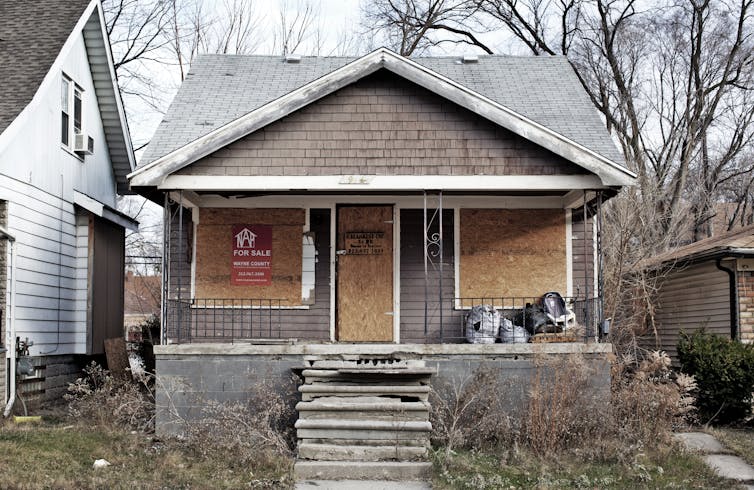
The chronic lack of population creates a big non -agreement on the actual estate market. A continued reduction in demand for living space results in an oversupply of Free Real Estate. Empty characteristics can deteriorate quickly as a result of neglect, arson, vandalism and crime.
Charles Ommanney about Getty Images
The rehabilitation of abandoned and neglected properties is usually impossible. It can only take just a few years at no cost houses to vary habitable to moist. What should political decision -makers do with the growing undesirable inventory?
One way is to do nothing and wait for real estate developers to scrub up the packages and hopefully rebuild.
In the absence of measures by the private sector, which are sometimes unable Remove shitty properties and stabilize the neighborhoods. Detroit did that Since 1974. As a result, 17% of town's land area is now consist of free land Where houses once stood.
As a gaggle of Economist Who studies Municipal financing In the cities that have the population decline, we’ve looked deeply on the success of destructive, incorrect real estate in Detroit.
Detroit removes hundreds of mischiefs
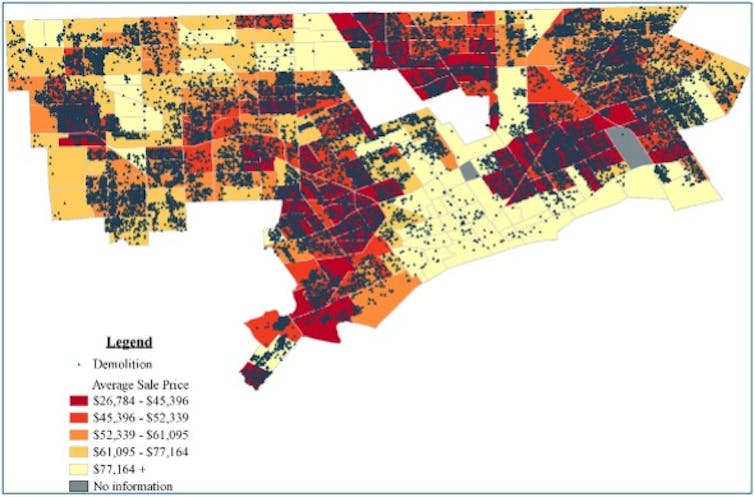
Between 2014 and 2019, The city destroyed 20,800 missed real estate Through the Detroit demolition program. The most difficult concentration of demolition occurred in probably the most lowest rated areas in town similar to the districts of Brightmoor, Burank and in the center west.
Alvayay Torrejón, Paredes, Skidmore (2023)Present CC BY-NC-ND
From 2014 to 2019, many were financed by the Federal Government The hardest hit fund. The aim of the fund is to scale back enforcements for homeowners and to stabilize the neighborhoods. This fund spent 52 million US dollars to tear down houses in Detroit.
As with any state intervention, it will be important to guage costs and benefits in order that the managers can make sure that they implement probably the most effective revitalization strategy.
Costs and benefits of demolition
Studies show that demolition not only eliminate the failures, but in addition, but in addition, but in addition the Stabilize the residential values of the neighborhoodPresent Improvement of compliance with property taxPresent Reduce crime and eliminate toxic materials similar to Asbestos and lead paint.
From the angle of town funds, the success of the destruction of a property may be assessed in two ways.
First, does it increase the worth of the nearby real estate? A study that two of us published in 2017 answered this query within the affirmative: tearing off an abandoned constructing in Detroit increases the worth of the nearby real estate by a low amount: $ 162.
Second, how do changes in the worth of this nearby real estate affect Detroit's property tax revenue? If the actual estate values increase, the property taxes are also increasing in order that it is feasible to calculate how long it takes for town to get its costs back. Average, The demolition of a decorated structure in Detroit costs 21,556 US dollars.
In the case of Detroit in the course of the examined period, our research shows some great benefits of this system in relation to Increased real estate values are limited And don’t fully cover the demolition costs.
Even in case you take over optimistically that some great benefits of the demolition to real estate as much as about 2½ blocks will remove, the rise within the property tax revenues generated by demolition is just too small so as to cover the demolition costs.
To understand why, imagine that you simply are pulling a circle across the destroyed property with a radius of about 0.125 miles, as we’ve defined 2½ city blocksAnd then to examine the change in the actual estate value and the tax revenue of the actual estate inside the district. Removing a decorated property is a victory in some ways, but has no major influence on the neighboring house values.
Our results show that free properties are also negatively affected on the property values of the encircling houses. For example, for houses inside 2½ city blocks, the web effect of a demolition without renovation is a rise in neighboring nobility prices of $ 162. In this case it could take 50 years for money to be levied by property taxes correspond to the prices of the demolition. It is difficult to say what happens when the lot is being developed because there are so few.
If you measure the effect based on smaller rings across the destroyed property, the entire costs for the associated fee restoration will likely be even longer.
State and federal support
But in the long term these are demolition Essential for maintaining the standard of life and positioning town for future renovation. Some would argue that it’s the role of the federal government to pay for such programs in fighting cities. Under President George W. Bush, for instance, the US Ministry of Housing and Urban Development Neighborhood stabilization programThe funds for them contained Demolition of merged structures.
From 2014 to 2019, the federal government's most powered fund covers most of the demolitions in Detroit. When this program ended, The city voters showed their enthusiasm for the removal of faulty real estate by approval of proposal nA $ 250 million financed by Detroit to proceed the demolition program.
However, additional basic taxes to cover the demolition costs may give town a competitive drawback within the region nationally and worldwide. Detroit has already under the highest basic taxes within the country.
The allowance of the state to begin the laws would keep the property taxes reasonably priced, however the support for such programs is mixed within the state captain in Lansing as a result of resource restrictions and the indisputable fact that other Michigan cities similar to Flint also must struggle with a decline in population.
Lessons from Detroits Rahne pulled
Detroit and other post -industrial American cities similar to Cleveland, OhioAnd Gary, Indianahave experienced the population declines in recent many years, but these challenges are under no circumstances exclusively a phenomenon of the United States.
In the course of history, Cities like Rome have experienced enormous population waste. Paris lost the population in Middle Ages. Some old cities like Carthage And Petra were completely left.
In the approaching years, Japan, Korea and numerous European countries are on the precise track Experience a big decline in population. Many Resource -dependent cities in China have the identical problem.
This implies that the teachings drawn by Detroit may be helpful for political decision -makers elsewhere. Many leaders in Detroit didn’t imagine that the population would shed extra pounds over many years, they usually didn’t plan it.
Other cities have the chance to organize. You can first diversify your economies and sources of income for town in order that the federal government has funding and make sure that the standard of life is maintained when the population is shrinked.
image credit : theconversation.com