


Valentine's Day often conjures up pictures of chocolates and romance. But the harvest behind this pleasure is exposed to an existential threat.
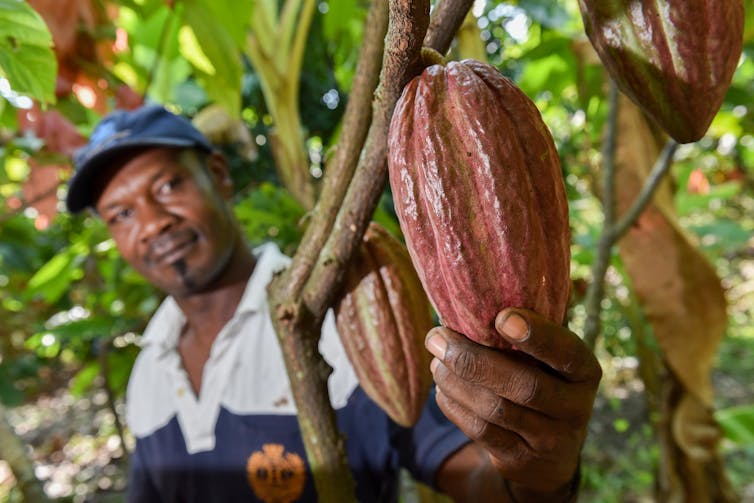
Regions reminiscent of Northeasters Brazil, one among the remarkable coconut-producing areas on the planet, occur with increasing drought-a slow but relentless drying of the country. Cocoa consists of the beans of the cocoa tree, which thrives in damp climate zones. The harvest is to fight in these drying regionsAnd also the farmers who grow.
This shouldn’t be just the history of Brazil. All of West Africa, where 70% of the world cocoa are grownAnd in America and Southeast Asia, the shift in moisture levels threaten the sensitive balance that’s required for production. In these regions wherein energetic ecosystems and global bread baskets that feed the world are on the front -line of slow but relentless progress of dryness.
© 2017ciat/NeilpalmerPresent CC BY-NC-SA
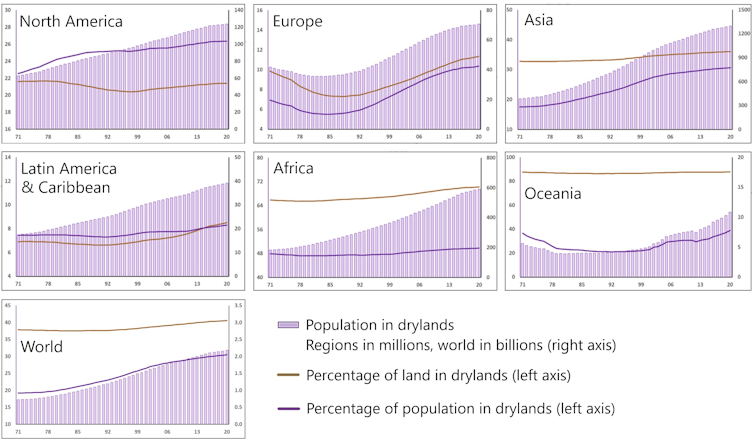
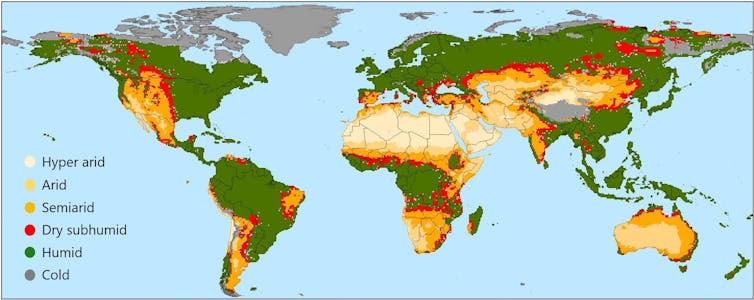
More than three quarters of the land mass of the earth up to now 30 years has turn out to be drier. A brand new report I helped with the coordination For the United Nations Convention to combat desert formation, drying areas now cover 41% of the worldwide country, an area that expanded by almost 1.7 million square kilometers (4.3 million square kilometers) in these three many years – about half As big as Australia.
This creeping dryness shouldn’t be only a climate phenomenon. It is a Long -term transformation that may be irreversible And that has devastating consequences for ecosystems, agriculture and livelihood worldwide.
What causes dryness?
The drought is commonly considered purely as a climate phenomenon, but that’s that Result of a posh interaction Under human -driven aspects. This includes greenhouse gas emissions, land use practices and the deterioration of critical natural resources reminiscent of soil and biological diversity.
These interconnected forces speed up the conversion of single -productive landscapes into increasingly dry regions, with the results within the ecosystems and economies.
Greenhouse gas emissions: a worldwide catalyst
The climate change induced by humans is the fundamental driver for increasing drought.
Greenhouse gas emissionsThe global temperatures increase specifically by burning fossil fuels and deforestation. Rising temperatures in turn result in moisture evaporating faster. This increased evaporation reduces the soil and the plant moisture and exacerbates the water shortage – even in regions with moderate precipitation.
The dryness began Accelerated worldwide within the FiftiesAnd the world has modified a pronounced change up to now three many years.
This process is especially strong in regions which can be already liable to drought, reminiscent of. Africa's Sahel region And The Mediterranean. In these areas, a reduced precipitation – combined with increased evaporation – creates a feedback loop: dry floors absorb less warmth, the atmosphere warmer and intensified dry conditions.
UNCCD
Non -sustainable land use practices: a hidden accelerator
The weight remains to be influenced by How people use and manage land.
Non -sustainable agricultural practices, indictions and deforestation floors of their protective vegetation coverage, which implies that they’re liable to erosion. Industrial cultivation techniques often prioritize short -term returns against long -term sustainability, exhaustion of nutrients and organic substance essentially For healthy soils.
For example in regions for coconut -producing regions reminiscent of Northeast of BrazilDeforestation to make room for agriculture disturbs the local water cycles and exposes floors to deterioration. Without vegetation to anchor it, the highest floor – critically critically for plant growth – washes away through the precipitation or is overwhelmed by winds, take with vital nutrients.
These changes Create a vicious circle: The degraded floors also hold less water and result in more drains, which reduces the country's ability to loosen up.
Chad of the United NationsPresent CC BY-NC-SA
The soil biological diversity connection
The soil, which is commonly missed in discussions in regards to the resistance of the climate, plays a vital role in reducing drought.
Healthy soils act as reservoirs and store water and nutrients on which plants depend. They also support biological diversity under and above the earth. A single teaspoon of soil accommodates billions of microorganisms that help cycling nutrients and maintain the ecological balance.
However, if the floors deteriorate under drought and mismanagement, This biological diversity is reduced. Microbial communities, essential for the nutrient cycle and the health of plants, decline. When the floors are compressed and losing organic substance, the country's ability to maintain water decreases, which makes it much more vulnerable to dry out.
In short, that Loss of soil health creates cascading effects This undermines ecosystems, agricultural productivity and dietary security.
Global hot spots: impending dietary safety crises
Cocoa is only a harvest that’s affected by the intervention with increasing drought.
Other necessary agricultural zones, including the Bread baskets on the planet are also in danger. In the MediterraneanAfrica Sahel Parts of the USA WestDryness already undermines agriculture and biological diversity.
Around 2100, Up to five billion people Could live in dry areas – almost twice as high as the present population in these areas, each due to population growth and the expansion of dry areas when the planet heats up. This exerts immense pressure on the food systems. Migration as a declining agricultural productivity, lack of water and deterioration in living conditions can even speed up rural population groups to maneuver to maneuver Looking for opportunities.
UNCCD
Aruidy's Ripple effects also go far beyond agriculture. Ecosystems which can be already contaminated by design and pollution are emphasized when water resources disappear. Wild animals wanders or dies and vegetable species which can be adapted to the meter conditions cannot survive. For example, the sensitive grass landscapes of the Sahel zone are quick Soft to the desert bushes.
In the worldwide level, economic losses in reference to aridification are astonishing. In Africa, increasing drought contributed to A 12% decline in gross domestic product From 1990 to 2015. Sandstorms and mud storms, forest fires and water shortages will proceed to burden the governments that tighten poverty and health crises in essentially the most affected regions.
The way forward
The drought is neither inevitable nor its effects completely irreversible. However, coordinated global efforts are of essential importance for holding progress.
Countries can work together to revive degraded land by protecting and restoring ecosystems, improvement of soil health and Promotion of sustainable agricultural methods.
Municipalities can manage water more efficiently through rainwater harvesting and advanced irrigation systems that optimize water consumption. Governments can reduce the drivers of climate change by investing in renewable energies.
Continuation International cooperationIncluding working with firms, can assist to exchange technologies in an effort to make these actions simpler and available worldwide.
So if you enjoy this Valentine's Day chocolate, remember the delicate ecosystems behind it. The price of cocoa in early 2025 was near his Always highPresent partly as a consequence of dry conditions in Africa. Without urgent measures to address the drought, this scenario can turn out to be more common, and cocoa – and the sweet production derived from it – can actually turn out to be a rare luxury.
Collective measures against dryness shouldn’t be nearly saving chocolate, but the power of the planet to take care of life.
image credit : theconversation.com